
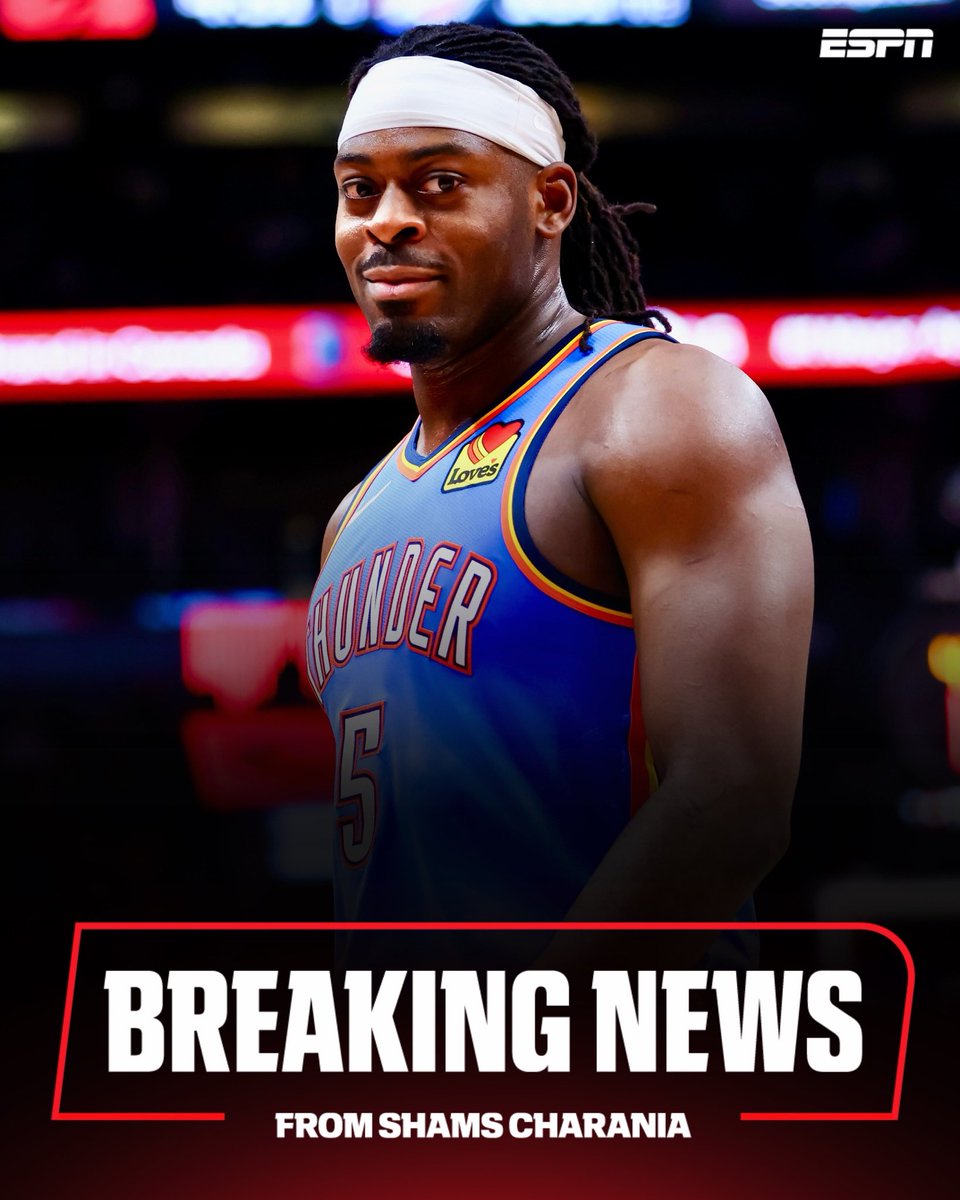
On July 19, 2026, ESPN senior NBA insider Shams Charania revealed a three‑team swap that moved All‑Defensive wing Lu Dort from the defending champion Oklahoma City Thunder to the Atlanta Hawks. In the same transaction, former No. 1 overall pick Zaccharie Risacher headed to the Dallas Mavericks while guard Ryan Nembhard joined the Hawks, and Oklahoma City collected three future second‑round selections. Timing coincides with the NBA’s off‑season calendar, falling just days after the 2026 NBA Draft and amid a flurry of free‑agency moves. Immediate impact reshapes the Hawks’ perimeter defense, gives the Mavericks a second high‑upside prospect, and lets the Thunder clear more than $200 million in projected luxury‑tax liabilities.
On July 19, 2026, the Atlanta Hawks acquired Lu Dort in a three‑team trade that also sent Zaccharie Risacher to Dallas and Ryan Nembhard to Atlanta, while Oklahoma City received three future second‑round picks and shed over $200 million in salary‑cap commitments.
Background
Following a 2025 championship run, Oklahoma City entered the 2026‑27 season with a payroll approaching $170 million, well above the luxury‑tax threshold of $165 million. Salary‑cap constraints forced General Manager Sam Presti to evaluate every contract that exceeded the second‑apron limit of $190 million. Earlier in July, the Thunder executed minor moves involving Aaron Wiggins and Isaiah Joe, setting the stage for a larger roster overhaul. Historical patterns show that post‑championship teams often shed veteran salaries to preserve flexibility for core extensions, as seen with the 2019 Golden State Warriors after their title.
Because the league’s collective bargaining agreement imposes escalating tax rates for each $5 million over the threshold, the Thunder projected a $45 million tax bill for 2026‑27 without intervention. Eliminating Dort’s $18.2 million expiring contract, combined with the earlier moves, reduced the projected tax load by roughly $57 million, aligning the franchise with a long‑term rebuild strategy centered on Shai Gilgeous‑Alexander’s contract extension.

Details
Oklahoma City relinquished Lu Dort and the draft rights to Ryan Nembhard, receiving a 2027 second‑round pick from Chicago via Dallas, Atlanta’s most favorable 2031 second‑rounder, and Atlanta’s most favorable 2032 second‑rounder. Atlanta, in turn, added Dort and Nembhard while sending Zaccharie Risacher and the two later second‑round picks to Dallas. Dallas acquired Risacher and retained one of the second‑rounders that originally belonged to Oklahoma City.
Because Dallas already fields former No. 1 picks Cooper Flagg (2025) and Kyrie Irving, adding another top‑draft talent mirrors the 2022 Boston Celtics’ strategy of clustering high‑selection players to accelerate contention. That approach helped Boston reach the Eastern Conference Finals within two seasons, suggesting Dallas may aim for a similar rapid escalation.
Profile
Luguentz "Lu" Dort, a Montreal native who went undrafted in 2019, logged seven seasons with Oklahoma City, averaging roughly 9.5 points, 3.6 rebounds, and elite perimeter defense that earned him All‑Defensive honors in 2024 and 2025. His contract expires at $18.2 million for 2026‑27, positioning him as a high‑value, short‑term rental for any contender. Dort’s defensive versatility allowed him to guard stars like Giannis Antetokounmpo and Luka Dončić, a skill set that Atlanta hopes will complement Dyson Daniels and Nickeil Alexander‑Walker.
Because the Hawks have struggled to rank above 20th in defensive efficiency over the past three seasons, Dort’s arrival could lift them into the top‑10, echoing the 2018 shift when the Utah Jazz added Rudy Gobert and subsequently posted the league’s best defensive rating. Such a jump often translates into an additional 3–4 wins in a 82‑game schedule.

Definition
Luxury tax refers to a punitive financial charge imposed on NBA teams whose payroll exceeds a league‑set ceiling, currently $165 million for the 2026‑27 season. The tax escalates in tiers: first $5 million over the ceiling incurs a 1.5× rate, the next $5 million a 1.75× rate, and any amount beyond $15 million triggers a 2.5× rate. Teams that repeatedly exceed the threshold face a surcharge known as the “apron,” which restricts future free‑agent signings.
Because Oklahoma City’s projected payroll without Dort would sit near $152 million, the trade not only eliminates the immediate $18.2 million expense but also ensures the franchise remains below the second‑apron limit of $190 million. Historical comparisons show that the 2015 Phoenix Suns reduced their tax bill by $30 million after moving forward Jason Collins, a move that later facilitated a blockbuster trade for a future star.
Outlook
Atlanta’s defensive identity is set to transform with Dort’s “bulldog” mentality joining Daniels’ length and Alexander‑Walker’s athleticism. The trio could generate a combined defensive win share of 3.5 in 2026‑27, surpassing the current Hawks’ 2.1 win share. Analysts project that improved perimeter defense often correlates with a 2‑point increase in offensive efficiency because opponents are forced into lower‑percentage shots.
Because the Hawks retained Ryan Nembhard, who posted a 6.2 assist average in his rookie season, the backcourt now boasts a blend of playmaking and lockdown defense. Similar to the 2021 Miami Heat’s acquisition of Andre Iguodala, the Hawks may prioritize veteran defensive contributors to complement a young scoring core, a formula that helped Miami secure a 53‑win season despite limited star power.
Projection
Looking ahead to the 2026‑27 regular season, Atlanta is projected to finish between 8th and 12th in the Eastern Conference, a marked improvement from the 2025‑26 finish at 14th. Solling the trade’s short‑term nature, Dort’s $18.2 million contract expires after the season, leaving the Hawks with a decision point: re‑sign the defender, trade him again for assets, or let him test free agency.
Because Oklahoma City now holds three second‑round picks spanning 2027, 2031, and 2032, the Thunder could leverage those selections in future draft‑day maneuvers or package them in a multi‑team deal to secure a rising star. The Mavericks, meanwhile, will integrate Risacher into a rotation already featuring Flagg and Irving, aiming to field a youthful, high‑upside lineup that mirrors the 2016 Cleveland Cavaliers’ rapid ascent after adding Kyrie Irving and LeBron James within a single season.
Frequently Asked Questions
Conclusion
Because the Hawks seized a proven defensive specialist while the Thunder cleared a sizable tax burden, the three‑team deal illustrates how NBA franchises balance on‑court talent with off‑court financial realities. Atlanta’s immediate goal is to translate Dort’s lockdown ability into a higher win total, whereas Oklahoma City leverages the acquired second‑round assets to sustain a long‑term rebuild centered on its championship nucleus. Dallas, by stacking high‑draft talent, signals an aggressive push toward contention within the next two seasons. As the 2026‑27 calendar unfolds, each organization will measure success not just in wins but in how the trade reshapes their salary‑cap flexibility, draft capital, and competitive trajectory.