
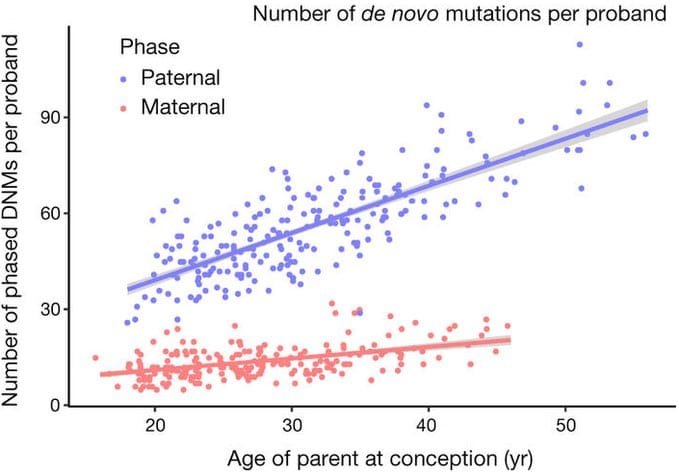
Men produce sperm continuously throughout life, causing genetic errors to accumulate with age. By a father's early thirties, sperm can carry roughly 50 percent more new mutations than sperm from an 18-year-old, meaning children born to older fathers have a significantly higher risk of certain genetic disorders.
Geneticists rarely enter the arena of online cultural debate, but a recent viral post on X has forced the conversation onto their turf. The argument centers on a raw, unvarnished truth about human reproduction that scientific literature has proven for decades but popular culture largely ignores. A user named @JezziiB shared a screenshot of a post by @DaizyZeeX, which pointed out a stark statistical reality: fathers contribute vastly more new mutations to their children than mothers do, and those mutations increase with age. The post was accompanied by a graph showing a dramatic upward slope for male biological input compared to a flat line for females, sparking a massive reaction. This isn't just theoretical arithmetic; it creates a concrete biological collision course between modern life expectancy and the biological limits of human fertility. The science suggests that men have a ticking clock that operates differently than the one women face, yet it carries an equally heavy weight for the next generation.
The Germline Evolution Problem
The core of this scientific debate lies in how reproductive cells are made. A human being starts as a single fertilized egg, which must divide trillions of times to create a fully formed infant. Every single division carries a small risk of a copying error in the DNA sequence. In women, the eggs are already formed before birth, and they do not divide again except to release one egg every month. Consequently, a woman's eggs retain the same genetic fidelity from birth until menopause. In men, however, sperm is produced continuously through a process called spermatogenesis. Sperm precursor cells, called spermatogonia, divide constantly throughout a man's life to create fresh sperm.
This continuous division is the source of the biological clock. Each round of cell division provides another opportunity for a mistake. By the time a man is 20 years old, those precursor cells have divided approximately 150 times. By age 50, the number of divisions climbs to over 800. The mutations don't show up in the man's own body because they are corrected, but they ride along on the sperm ready to be passed to the child. This is a textbook example of evolutionary entropy, where the accumulation of errors over long periods outpaces the body's ability to maintain perfect genetic code. The earlier a man fathers a child, the fewer "generations" of cell division have occurred in his sperm, theoretically resulting in a cleaner genome for the offspring.
The Heavy Load of a Paternal Age Effect
Statistics on this phenomenon paint a stark picture. Broadly speaking, fathers are responsible for about 75 to 80 percent of all new mutations found in children. This statistic holds true across many species, including primates, but the implications are most potent in humans because of our long lifespan. Recent research utilizing advanced sequencing technologies, such as NanoSeq, has refined these estimates. These studies confirm that the number of new mutations roughly doubles for every 10-year increase in paternal age, aligning with the viral claims of the social media posts.
While the vast majority of these mutations are harmless "junk" DNA, the risk of harmful variation increases with age. A recent clinical review indicated that sperm from men in their early thirties carries disease-causing mutations in about 2 percent of cases. This figure can climb to 3 or 5 percent or higher in men over 50. This accumulation creates what scientists call a "paternal age effect" (PAE), a pattern where the risk of specific disorders rises predictably with the father's age. It challenges the traditional narrative that only maternal age is a concern, forcing a re-evaluation of when is the "right" time to start a family from a purely biological standpoint.
Selfish Genes and Mutation Clusters
Why do some mutations seem to cluster in specific families and spike with age? The answer lies in a phenomenon known as "selfish spermatogonial selection." Some mutations affect genes that regulate cell growth and division, such as *FGFR2*, *FGFR3*, and *HRAS*. These aren't random errors; they are advantageous for the sperm cell itself. A sperm cell carrying a mutation in a growth factor gene might divide more rapidly or outcompete its neighbors. This gives the mutant sperm a proliferative advantage, allowing it to clone itself and dominate the sperm count.
Think of this process as an internal arms race within the testes. Older testes provide a fertile ground for these "cancer-like" clonal expansions to take hold because the tissue environment changes over time. This mechanism explains why advanced paternal age is not just a smooth, linear increase in risk but a jagged one, linked to specific dominant disorders like Apert syndrome and achondroplasia. While the statistical probability of any single mutation rising is low, the clonal expansion of "selfish" mutations means that as a man ages, the pool of sperm he contributes to conception becomes increasingly dominated by cells that might not be the healthiest options for the child.
Health Consequences for Offspring
The downstream effects of this biological reality are measurable and significant. Epidemiological studies have long linked advanced paternal age to various health outcomes in children. Children born to older fathers face a higher statistical risk of neurodevelopmental disorders, including autism, schizophrenia, and ADHD. The risk does not vanish entirely for younger fathers but rises in a predictable gradient as the father's age increases. Beyond the brain, these children have a greater chance of facing congenital heart defects, cleft palates, and low birth weight.
This connection between a father's age and a child's health is a powerful illustration of how long-term human evolution interacts with modern medicine. In the past, men who fathered children at an older age might have been seen as having high social status or resources, traits that were passed on. Modern medicine allows men to remain biologically fertile well into their 50s and beyond, a luxury their ancestors rarely enjoyed. However, the genetic "quality control" mechanisms that ensure a healthy offspring have not evolved to match this new lifespan. The body is still operating under the assumption that reproduction happens much earlier in life, which creates a mismatch between reproductive capability and biological safety.
The Viral Backlash and Gender Dynamics
The viral nature of the X post by @JezziiB stems from its timing and tone. While the science is not new, the cultural context is shifting. Society has long placed the burden of fertility decline squarely on women, treating menopause as the capstone of female biology. The graphic showing the flat maternal line versus the climbing paternal line serves as a visual rebuttal to that narrative. It suggests that the "biological clock" is not a construct of misogyny but a hard mathematical reality that affects both sexes, albeit in different ways.
Reactions to the post reveal the friction between scientific fact and social comfort. The sarcastic caption "Well well well, look who actually has a biological clock" cuts through the polite conversation surrounding reproductive timing. It highlights a hypocrisy in how society discusses these issues. While a woman over 35 is often viewed with concern or pity for her fertility window, a man over 45 is frequently celebrated for his career success. The post suggests that prioritizing career or lifestyle over biological timing carries a genetic cost that is often ignored. This viral moment forces the conversation out of the sterile environment of medical journals and into the messy, emotional arena of social media, where the raw math of biology meets the nuance of human choice.
Future Outlook
As men in developed nations continue to delay parenthood, the biological clock is becoming a matter of public health policy. The Rutgers review from 2019 was a watershed moment that suggested men consider sperm banking before turning 35. More recent studies, including those from the mid-2020s, reinforce this urgency by quantifying the rapid increase in mutation load. The conversation is moving toward a future where reproductive counseling includes genetic risk assessment for men just as routinely as it does for women.
This shift might require a rethinking of how society values fatherhood. If the biological evidence shows that younger fathers statistically produce healthier offspring with fewer genetic complications, that value system needs to adjust. It does not mean older fathers are irresponsible or that they should be penalized, but it does mean the equation for starting a family has a new, complex variable to consider. As the science becomes more precise, the debate will likely shift from "is this happening?" to "how do we manage this risk?" The viral post was a spark, but the fire it reveals is a fundamental change in our understanding of human genetics.
Frequently Asked Questions
Conclusion
History offers a clear precedent for how society reacts when a biological fact clashes with cultural norms. In the mid-20th century, the medical community resisted admitting that smoking caused lung cancer for years, driven by economic interests and the slow accumulation of data. The current debate surrounding paternal age may play out similarly. The science is undeniable, yet the cultural friction regarding when men should father children remains intense. Just as the medical establishment eventually had to accept the link between smoking and illness to protect public health, society may eventually have to integrate the reality of the paternal age effect into social etiquette and healthcare policy. The viral post was merely the first crack in the door; the full implications are still being debated in the laboratory and the living room.