
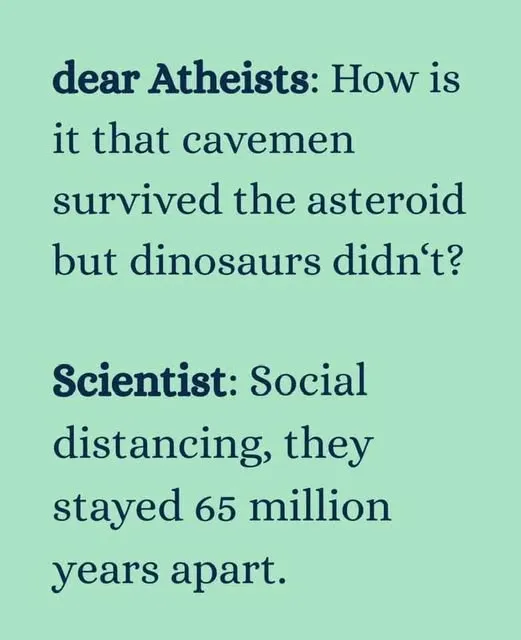
The internet can serve as a mirror for public knowledge, flashing back flaws in how populations process scientific data. A post from X user @genej101 on July 16, 2026, captured this dynamic perfectly. The user, a Vietnam veteran who frequently posts about patriotism and skepticism, shared a simple image meme. The text read, "My laugh of the day. Science wins every time. And they are not all atheists." This post did not just get likes; it sparked a debate that touched on religion, evolution, and the timeline of life on Earth. The humor lies in a specific question posed to atheists: "dear Atheists: How is it that cavemen survived the asteroid but dinosaurs didn’t?" The punchline, provided by a character labeled "Scientist," replies with "Social distancing, they stayed 65 million years apart."
The meme jokes that cavemen avoided the dinosaur-killing asteroid because humans appeared millions of years after dinosaurs went extinct. The post highlights the scientific reality that humans and dinosaurs never coexisted.
The Viral Post and Its Meme
The image shared by @genej101 is a straightforward example of internet humor. It features bold text asking a question aimed at atheists regarding the survival of early humans. The punchline from the "Scientist" character uses a play on words to answer the question. This joke relies on a massive chronological error to be funny. The Chicxulub asteroid impact occurred approximately 66 million years ago. This event wiped out about 75% of Earth's species, including the non-avian dinosaurs. Modern humans, or Homo sapiens, emerged around 300,000 years ago. Our earlier hominin ancestors appeared millions of years after the extinction event, making the phrase "cavemen" scientifically inaccurate in this context.
This meme cleverly highlights the vast gap between the two time periods. Humans and dinosaurs never coexisted in a way that would allow "cavemen" to dodge the asteroid alongside the reptiles. The "social distancing" joke plays on this temporal separation. It underscores how evolutionary timelines make the initial question nonsensical from a scientific standpoint. The post garnered thousands of likes, reposts, and replies. Users praised the humor, while others debated faith, atheism, and education.
The Science Behind the Asteroid
To fully explain the meme, we must ground it in robust paleontology and geology. The asteroid that struck our planet was roughly 6 to 10 miles wide. It hit the Yucatán Peninsula in modern-day Mexico, creating the Chicxulub crater. The energy release was equivalent to billions of atomic bombs.
Immediate effects began in seconds. A massive fireball and shockwave vaporized everything nearby. Ejecta, or molten rock and debris, rained down globally, igniting wildfires. A magnitude 10+ earthquake and mile-high tsunamis devastated regions. Short-term global catastrophe lasted from days to years. Soot, dust, and sulfur aerosols blocked sunlight, causing an "impact winter." This event led to a global cooling of over 40 degrees Fahrenheit for years to decades. Photosynthesis collapsed, which in turn collapsed food chains. Acid rain altered oceans and soils. Those who study this period note that the asteroid did not just kill animals; it fundamentally reshaped the chemistry of the atmosphere and the climate of the planet, creating a harsh environment that few species could endure.
Why Some Species Survived
The impact of the asteroid was not uniform. It did not strike with enough force to destroy every living thing on Earth. The survivors included mammals, birds, and some reptiles. These groups possessed traits that allowed them to withstand the initial shock and the long-term environmental changes.
Small size helped. Small body size meant lower food requirements and the ability to hide in burrows or dense vegetation. High reproductive rates allowed populations to recover quickly from low numbers. Endothermy, or internal body heat regulation, provided a distinct advantage. Animals that could generate their own heat could remain active even when the world grew cold and dark. Birds, which are descendants of theropod dinosaurs, survived by nesting and keeping eggs warm. Their ability to fly also allowed them to escape localized disasters. This selective pressure favored animals that could adapt to rapidly changing conditions, a stark contrast to the massive, specialized dinosaurs that dominated the pre-impact world.
The Human Evolutionary Path
Modern humans emerged around 300,000 years ago in Africa. This timeline places our species firmly in the Cenozoic era, the "Age of Mammals." We did not inherit the Earth from the dinosaurs. Instead, mammals evolved in their shadow, adapting to the changing climate and filling ecological niches left vacant by extinct species.
The term "caveman" is a colloquialism that refers to early humans or prehistoric hominins. These individuals lived during the Paleolithic period, thousands of years after the dinosaurs vanished. They faced different challenges, such as ice ages and hunting large game, rather than asteroid impacts. The humor in the meme works because it ignores these distinct evolutionary histories. It treats millions of years of biological history as if it were a single, overlapping timeline. This conflation of timelines reveals a common misunderstanding of deep time. People often struggle to conceptualize dates that stretch back hundreds of millions of years, leading to questions that seem scientifically illiterate but are actually rooted in an intuitive, though incorrect, understanding of history.
Misunderstanding Science and History
The meme goes viral because it taps into a broader cultural tension. It highlights the clash between evidence-based reality and the persistence of myth or misunderstanding. For many believers, the idea of a literal interpretation of history conflicts with scientific findings. The post, while ostensibly about science, often sparks theological debates.
One reply noted that "most people haven’t a clue about reality." Another quipped about theists treating fictional narratives as documentaries. These comments suggest that the meme serves as a catalyst for exposing gaps in education. It forces a discussion that goes beyond a simple joke about dinosaurs. It brings into focus how people process information when it conflicts with established scientific consensus. The user @genej101 often shares content celebrating science and critical thinking. This specific post fits that pattern, blending wit with a push for evidence-based views. It suggests that public understanding of scientific concepts is still lagging behind the scientific community's understanding.
For more on this, see 230627123015.
For more on this, see how an asteroid caused extinction of dinosaurs.
Frequently Asked Questions
Conclusion
The viral post serves as a modern parable of knowledge. It shows how easily a joke can become a battleground for worldviews. The "social distancing" punchline is simple, but the discussion it generates is complex. It touches on the limits of human memory and the difficulty of conveying deep time to a general audience.
Scientific literacy requires more than memorizing dates. It demands an understanding of cause and effect over vast timescales. Similar to how the Victorians struggled to reconcile Darwinian evolution with scripture, today's internet users grapple with the implications of plate tectonics, deep time, and cosmology. The meme @genej101 shared is a symptom. It indicates that while science advances, the public conversation often lags behind, relying on simplified narratives that prioritize humor over accuracy. This gap suggests that education efforts must focus not just on facts, but on the frameworks of thinking that allow people to understand how the world actually works.